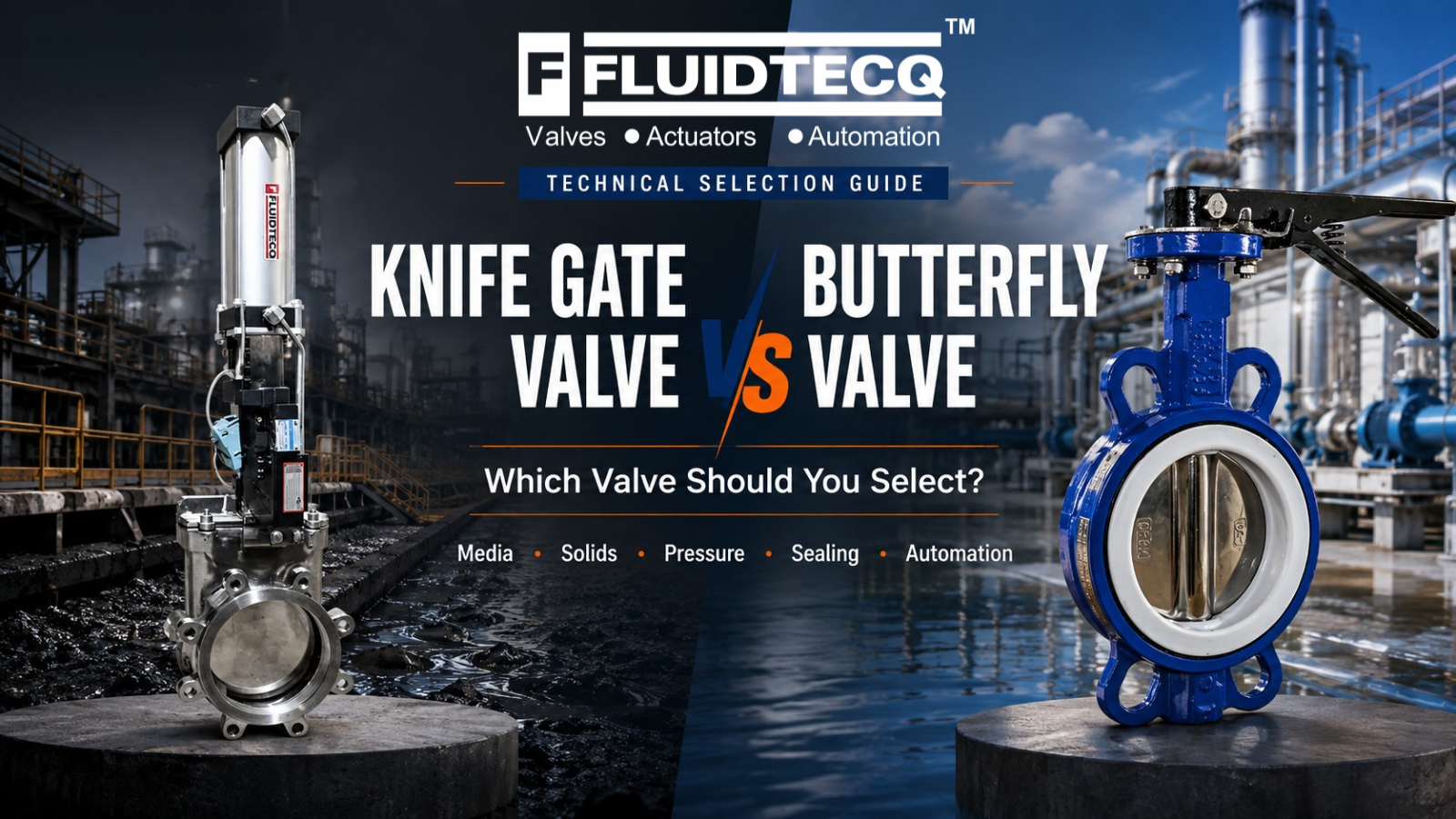
A knife gate valve and a butterfly valve can both be used for isolation duties, but that does not make them interchangeable.
The most important difference becomes apparent when we look inside the pipeline.
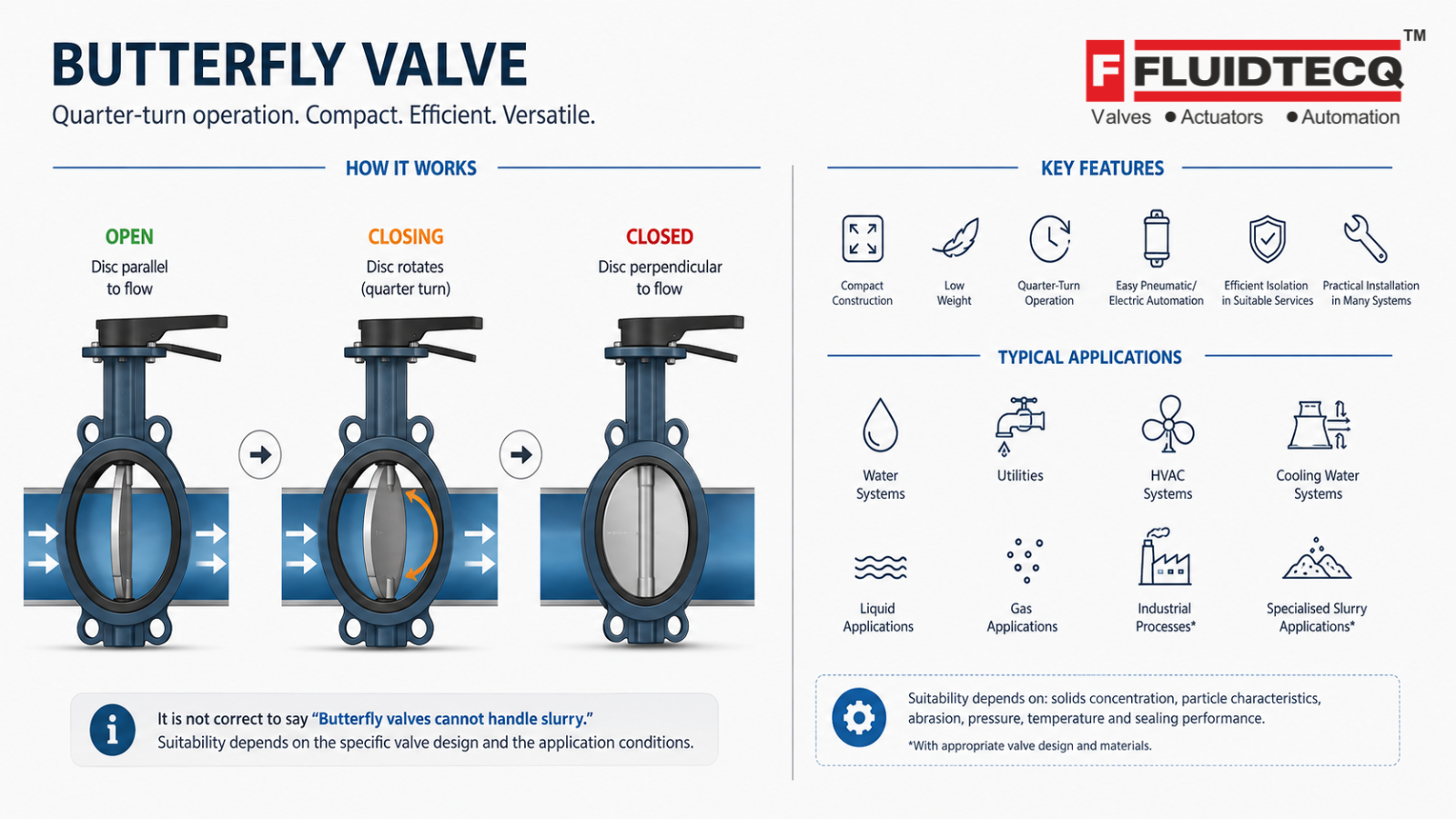
A butterfly valve places a rotating disc in the flow path. A knife gate valve uses a gate that travels across the flow path and retracts when the valve opens.
That difference in operating principle can significantly influence how each valve behaves when the process contains slurry, sludge, ash, fibres, suspended solids or abrasive particles.
The right question, therefore, is not:
Which valve is better?
The right question is:
Which valve is better suited to the media and operating conditions of this particular application?
This guide from Fluidtecq™ explains the practical engineering differences that should be considered before specifying either valve.
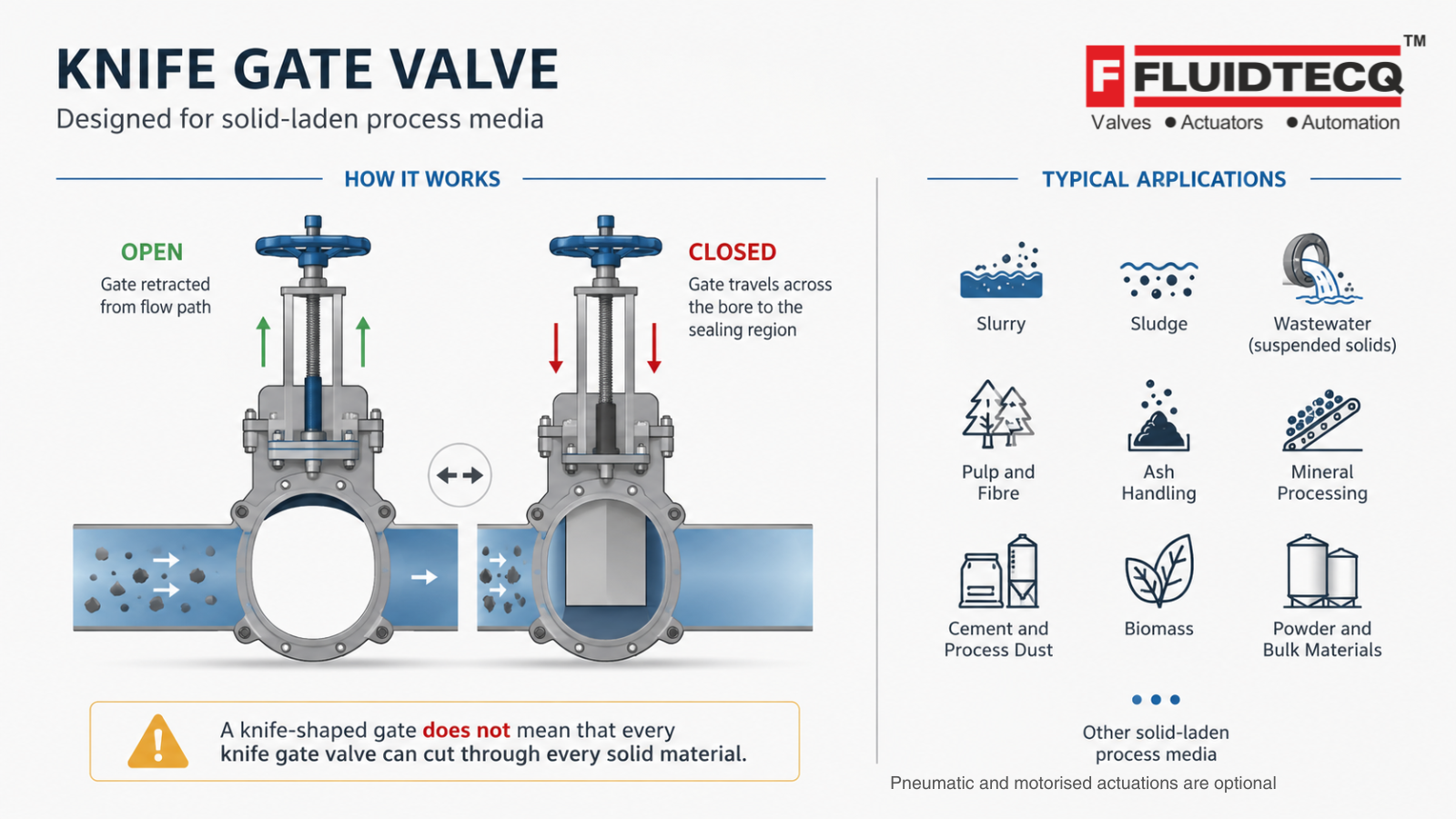
A knife gate valve uses a relatively thin gate or blade that moves linearly through the valve body.
When opened, the gate retracts from the flow path. When closed, it travels across the bore toward the valve's sealing region.
The design makes knife gate valves particularly relevant where the process medium contains solids or fibres that can make isolation difficult for some conventional valve designs.
Typical applications can include:
slurry
sludge
wastewater containing suspended solids;
pulp and fibre
ash handling;
mineral processing streams;
cement and process dust;
biomass;
certain powder and bulk-material systems; and
other solid-laden process media.
The exact valve construction must still be selected for the application.
A knife-shaped gate does not mean that every knife gate valve can cut through every solid material.
The disc rotates approximately a quarter turn between the open and closed positions.
Butterfly valves are widely used because they can offer:
compact construction
relatively low weight
quarter-turn operation
straightforward pneumatic or electric automation
efficient isolation in suitable services and
practical installation in many industrial piping systems.
They are commonly considered for water, utilities, HVAC, cooling-water systems and many compatible liquid or gas applications.
Depending upon construction, specialised butterfly valves can also handle more demanding industrial services.
This is why media description matters.
It would be technically incorrect to say:
“Butterfly valves cannot handle slurry.”
Some butterfly-valve constructions can be selected for certain slurry services.
The engineering question is whether the specific butterfly-valve design is suitable for the solids concentration, particle characteristics, abrasion, pressure, temperature and required sealing performance of the application.
Knife Gate Valve vs Butterfly Valve: The Fundamental Difference
Consider a pipe carrying relatively clean water.
A butterfly disc inside the flow path may not create a significant process concern.
Now consider a pipeline transporting:
thick sludge containing suspended solids.
The same geometry needs to be evaluated differently.
The disc, shaft, seat and sealing surfaces can interact with the solids passing through the valve.
A knife gate valve approaches the isolation problem differently because its gate retracts from the main flow path when fully open.
This fundamental difference is why knife gate valves are frequently evaluated for difficult solid-laden media.
Knife Gate Valve vs Butterfly Valve Comparison
Selection Factor
Knife Gate Valve
Butterfly Valve
Operating movement
Linear gate movement
Quarter-turn disc
Element in flow path when fully open
Gate largely retracts
Disc remains in bore
Clean liquid service
Application dependent
Commonly suitable
Slurry/sludge service
Frequently considered
Design/application dependent
Fibrous media
Frequently considered
Requires careful evaluation
Automation
Pneumatic/electric possible
Pneumatic/electric possible
Installation footprint
Face-to-face can be compact; actuator height must be considered
Generally compact
Throttling
Generally selected primarily for isolation
Some designs can provide control/throttling
Selection basis
Media + solids + pressure + temperature + materials + sealing
Media + pressure + temperature + materials + sealing
Important: This comparison is general guidance, not a substitute for application-specific valve selection.
When Should You Consider a Knife Gate Valve?
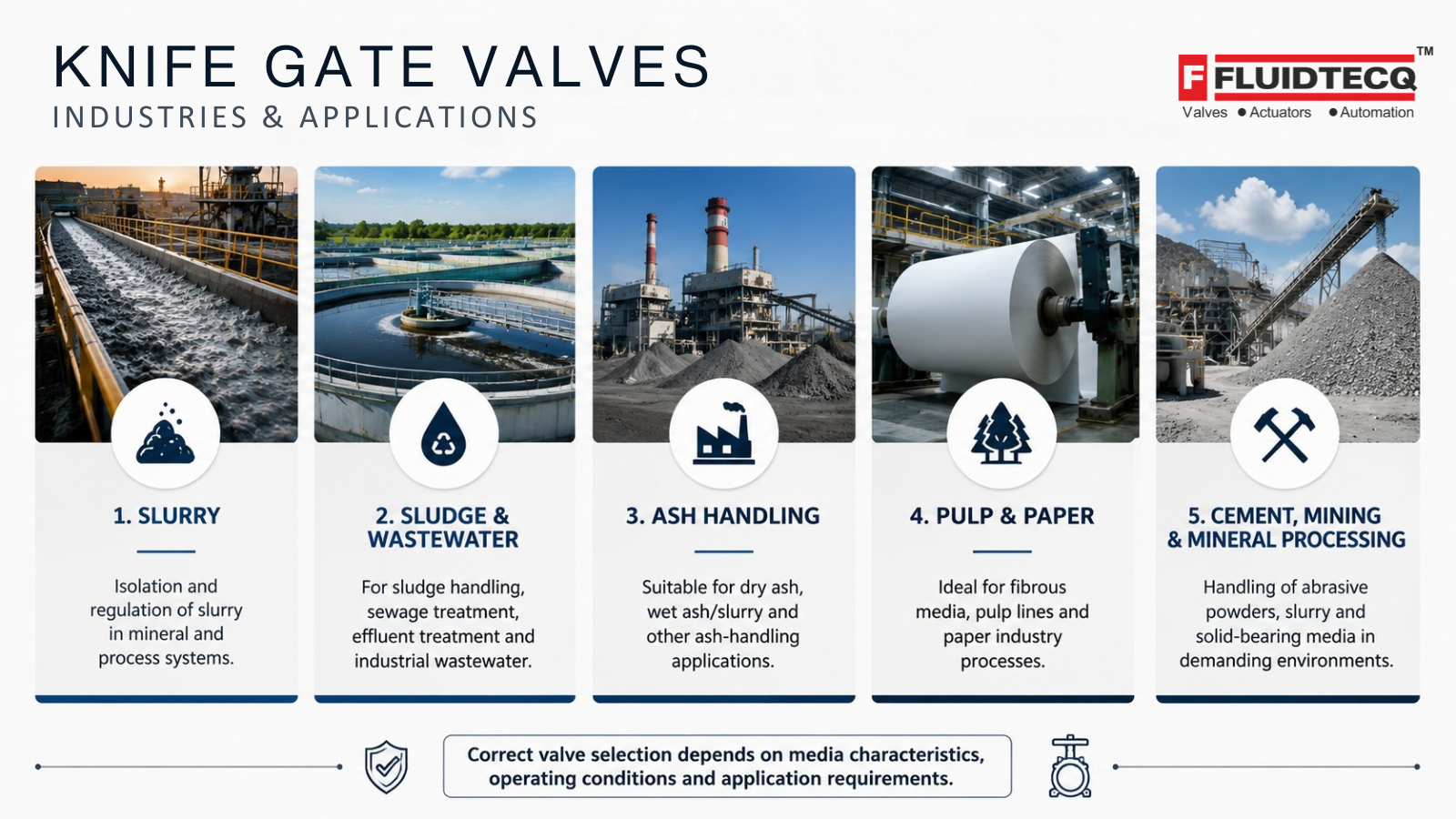
1. Slurry Applications
Slurry is not one uniform process medium.
A useful valve enquiry should describe:
carrier liquid;
solids concentration;
particle type;
approximate particle size;
abrasive characteristics;
tendency to settle;
pressure;
temperature; and
operating frequency.
For example, mineral slurry and wastewater sludge may both contain solids, but they present very different valve-selection challenges.
2. Sludge and Wastewater
Wastewater treatment processes can involve sludge, suspended solids, fibres and other contaminants.
Knife gate valves can therefore be considered at suitable points in:
sewage-treatment systems;
effluent-treatment plants;
sludge handling; and
industrial wastewater systems.
Material and seat selection should reflect the actual chemical and process environment.
3. Ash Handling
Power plants and industrial boiler systems may involve ash-handling applications.
Here, abrasion and solids behaviour can become important considerations.
Do not specify a knife gate valve merely as:
“For ash.”
Identify whether the application involves dry ash, wet ash/slurry or another process condition.
The correct construction can differ significantly.
4. Pulp and Paper
Fibrous media are one of the classic areas where knife gate valve geometry can be useful.
Pulp concentration, process chemicals, operating conditions and required sealing performance should still be provided when selecting the valve.
5. Cement, Mining and Mineral Processing
These industries frequently involve abrasive powders, slurry and solid-bearing media.
Valve selection should consider not simply the line size but also the nature of the material passing through it.
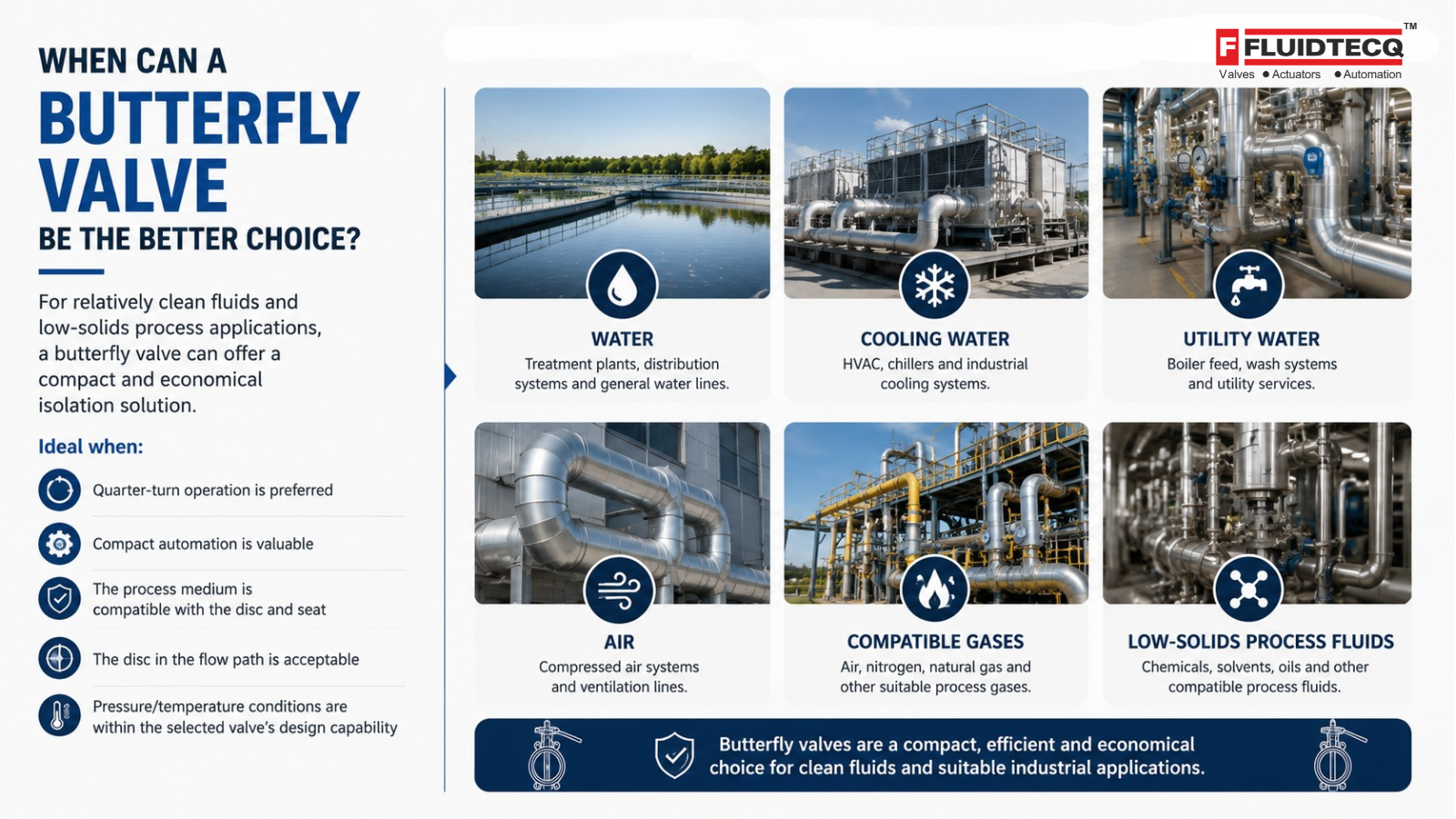
When Can a Butterfly Valve Be the Better Choice?
Knife gate valves should not become the automatic choice for every industrial pipeline.
For relatively clean fluids such as suitable:
water;
cooling water;
utility water;
air;
compatible gases; and
other low-solids process fluids,
a butterfly valve can offer a compact and economical isolation solution.
Butterfly valves are particularly attractive where:
quarter-turn operation is preferred;
compact automation is valuable;
the process medium is compatible with the disc and seat;
the disc in the flow path is acceptable; and
the required pressure/temperature conditions fall within the selected valve's design capability.
The nominal bore tells the manufacturer only one part of the application.
Two DN200 pipelines could require completely different valves.
One might carry wastewater sludge.
Another might carry abrasive mineral slurry.
A third could handle pulp stock.
All are DN200.
Their valve requirements may not be the same.
Seven Questions to Ask Before Choosing Between the Two
1. What Exactly Is Flowing Through the Pipeline?
Do not simply write “slurry.”
Describe it.
2. How Much Solid Content Is Present?
The presence, concentration and behaviour of solids can influence valve selection.
3. Are the Particles Abrasive?
Abrasive media can influence body, gate, seat and other material decisions.
4. What Are the Operating Pressure and Temperature?
These parameters affect valve construction, material selection, sealing and actuation.
5. Is the Valve for Isolation or Control?
Knife gate valves are generally selected primarily for isolation.
If the process requires modulating flow control, discuss the requirement before specifying the valve type.
6. How Often Will the Valve Operate?
A valve operating several times per shift has different automation considerations from an emergency isolation valve that rarely cycles.
7. What Happens if the Valve Fails?
This question influences actuation philosophy.
A pneumatic actuator may need to provide a defined response such as fail-open or fail-close, depending upon the process and actuator/control arrangement.
Seat Material Matters
Fluidtecq™ knife gate valve projects may involve seat materials such as:
EPDM;
NBR;
PTFE; and
Viton/FKM.
However, these materials are not interchangeable.
Selection depends on factors including:
process medium;
chemical compatibility;
temperature;
sealing requirements; and
operating environment.
For example, choosing PTFE simply because it is perceived as a “premium” material is not an engineering selection method.
The correct seat is the material suited to the actual application.
Application-specific selection is recommended. Send Fluidtecq™ your media details, operating pressure, temperature, material requirements and service conditions. Our team can review the application and recommend a suitable valve, seat, material and actuation configuration.
Body and Gate Material Selection
Depending upon the valve design and application, body and gate materials can include different metallic constructions.
For Fluidtecq™ enquiries, gate options may include grades such as:
SS304, SS316 or SS316L, depending upon application requirements.
Do not automatically assume that stainless steel is required everywhere.
Material selection should consider:
corrosion;
abrasion;
process chemistry;
temperature;
expected service life; and
commercial requirements.
Application-specific selection is recommended. Send Fluidtecq™ your media details, operating pressure, temperature, material requirements and service conditions. Our team can review the application and recommend a suitable valve, seat, material and actuation configuration.
Both knife gate and butterfly valves can be integrated into automated process systems.
A pneumatic knife gate valve can potentially incorporate accessories such as:
solenoid valve;
air filter regulator;
limit switches;
positioner where appropriate;
junction box; and
control-panel interface.
The final package depends on the plant's control philosophy.
This is why actuator selection should not happen independently from valve selection.
Actuator Sizing Is an Engineering Calculation
One common procurement mistake is selecting a pneumatic actuator simply because it appears mechanically compatible with the valve.
For a knife gate valve, the actuator must provide sufficient force under the specified operating conditions.
Relevant information can include:
valve size;
differential pressure;
media;
operating conditions;
available instrument-air pressure;
required operating action; and
appropriate design/safety factors.
The actuator should then be selected against the valve's required operating force.
Application-specific selection is recommended. Send Fluidtecq™ your media details, operating pressure, temperature, material requirements and service conditions. Our team can review the application and recommend a suitable valve, seat, material and actuation configuration.
Common Selection Mistakes
Several avoidable mistakes repeatedly appear in industrial valve procurement:
Choosing the lowest-priced valve without comparing construction.
Assuming every knife gate valve is identical.
Describing difficult media simply as “slurry.”
Selecting seat material without checking media compatibility.
Ignoring solids concentration and particle characteristics.
Specifying pneumatic actuation without stating available air pressure.
Forgetting automation accessories until after the valve has been ordered.
Involving the valve manufacturer only after piping, actuator and operating philosophy have already been finalised.
The last point is particularly important.
Early technical consultation can often reveal missing information before it becomes a procurement or installation problem.
Knife Gate Valve or Butterfly Valve? A Practical Selection Rule
There is no universal winner.
Think in terms of the process.
Start with a Butterfly Valve when:
The medium is relatively clean, quarter-turn operation is desirable, compact installation is important and the selected disc/seat/body construction is suitable for the operating conditions.
Evaluate a Knife Gate Valve when:
The process contains significant solids, slurry, sludge, fibres, ash or other media where a retracting gate configuration may offer an application advantage.
Then validate:
Media → Pressure → Temperature → Solids → Materials → Seat → Actuation → Accessories → Installation
That sequence produces a much better specification than choosing a valve from line size alone.
Frequently Asked Questions
Is a knife gate valve better than a butterfly valve for slurry?
Knife gate valves are frequently selected for slurry and other solid-laden media, but suitability depends on slurry composition, solids concentration, particle characteristics, pressure, temperature and valve construction. Some specialised butterfly valves can also handle certain slurry applications.
Can a butterfly valve handle sludge?
Potentially, depending upon sludge characteristics and valve design. High solids, fibres, abrasion or deposits may make a knife gate configuration more appropriate. The actual application should be reviewed.
Can a knife gate valve be used for water?
Potentially, but that does not mean it is the most appropriate or economical selection. For relatively clean water, butterfly valves are commonly considered.
Can knife gate valves be pneumatically operated?
Yes. Pneumatic actuation can be used where operating conditions, available air supply and required valve force are properly considered.
Can knife gate valves be electrically operated?
Electric actuation can be considered depending upon valve configuration and application requirements.
Are knife gate valves suitable for throttling?
Knife gate valves are generally selected primarily for isolation rather than continuous flow regulation. If throttling or modulating service is required, discuss the operating requirement with the valve manufacturer before selection.
What information should I send when requesting a knife gate valve quotation?
At minimum, provide valve size, process medium, pressure, temperature, solids information where relevant, material requirements if specified, seat requirement if known, actuation preference and available pneumatic air pressure where pneumatic operation is required.
Don't Choose the Valve First. Understand the Application First.
A valve that works reliably in one pipeline can be unsuitable in another pipeline of exactly the same size.
For slurry, sludge, ash, pulp, wastewater and other demanding industrial applications, share the operating conditions before finalising the valve specification.
Fluidtecq™ can review the application and help identify an appropriate Knife Gate Valve, actuation method and automation configuration for the project.



 by Hemal Mehta