Knife Gate Valve Selection Guide for your application | Fluidtecq
Jul 28, 2026
by Hemal Mehta
How to Select the Right Knife Gate Valve for Your Application
Introduction
Selecting a knife gate valve is not just a matter of picking a size off a catalogue page. The wrong choice shows up later as seat wear, incomplete shut-off, jammed gates, or unplanned downtime in a line that was never meant to stop. Knife gate valves are chosen specifically because the media they handle — slurry, ash, sludge, powder, pulp stock, abrasive fines — would damage or clog a conventional gate, ball, or butterfly valve.
This guide walks through the factors that actually determine valve suitability, then explains where automation adds real operational value, and where Fluidtecq fits into that selection and automation process.
Why Standard Valves Struggle with These Media
Most process media that call for a knife gate valve share a few difficult characteristics:
High solids content or suspended particulates
Abrasiveness that accelerates seat and body wear
Tendency to pack, cake, or build up around a seat
Semi-solid or fibrous consistency that resists a rotating disc or ball
A knife gate valve addresses this with a flat, sharp-edged gate that moves perpendicular to flow, cutting directly through the media rather than trying to seal around it. This is the core reason it is specified across ash handling, slurry lines, sludge dewatering, pulp stock, and effluent discharge — not because it is a cheaper alternative to a gate valve, but because the mechanism is fundamentally suited to difficult media.
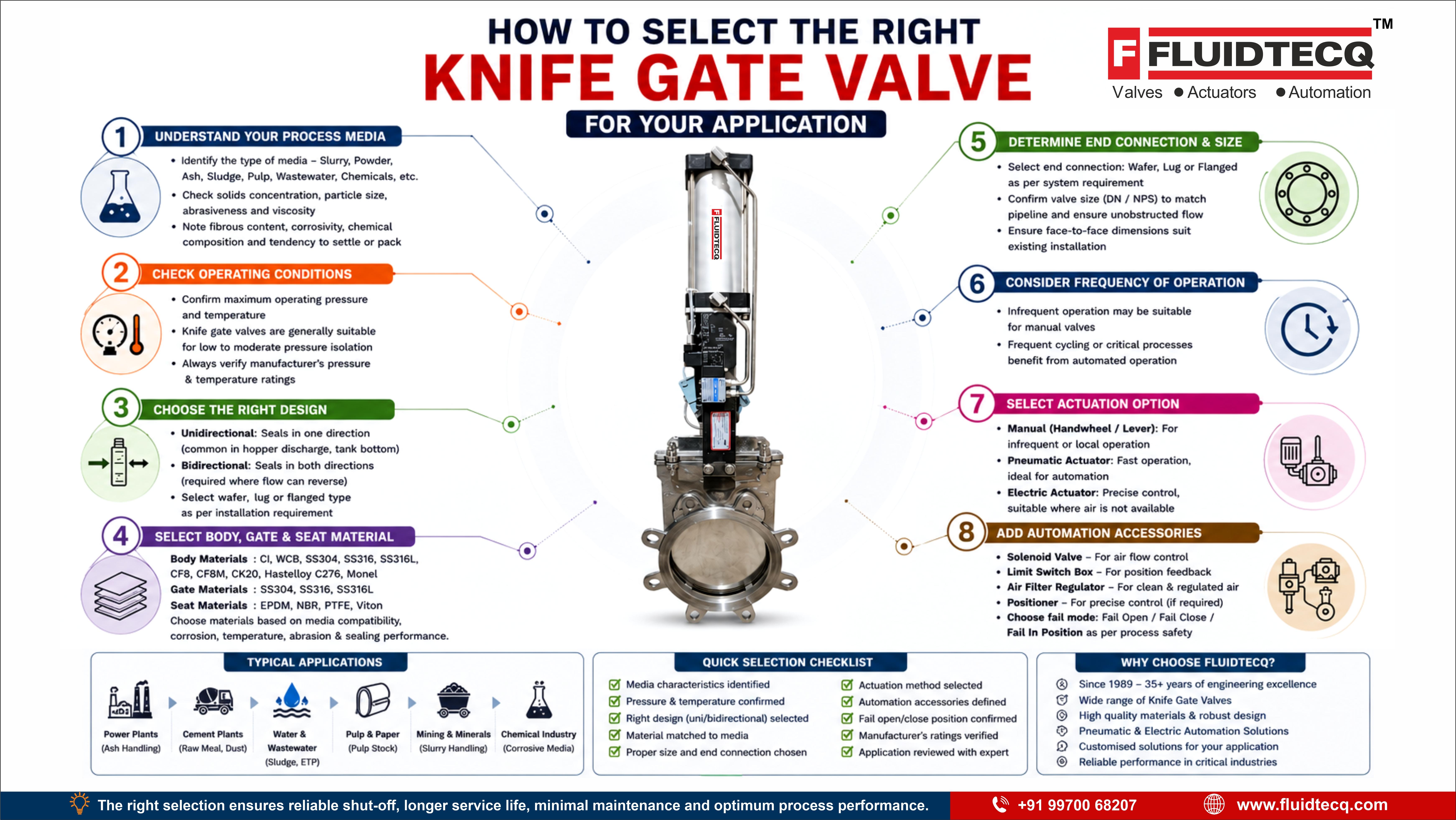
Before size or pressure rating, define the media itself:
Particle size and abrasiveness
Solids concentration (percentage by volume)
Fibrous or stringy content (common in pulp and paper)
Corrosivity or chemical composition
Tendency to settle or pack when static
2. Operating Pressure and Temperature
Verify the valve's pressure class against the process design conditions. Standard resilient-seated knife gate valves are typically intended for low- to medium-pressure isolation service, while specialised designs are available for higher-pressure applications. Always select the valve based on the manufacturer's certified pressure rating and the system design pressure against your process data sheet rather than assuming suitability.
The allowable operating temperature depends primarily on the seat material, packing arrangement, and body construction rather than the valve body alone. Always verify the recommended temperature range for the selected seat material before finalising the valve specification.
3. Unidirectional vs. Bidirectional Design
Unidirectional valves seal against flow in one direction — common where flow direction is fixed, such as hopper discharge or tank bottom isolation.
Bidirectional valves seal effectively in both directions — needed where flow can reverse, or where the valve may see back-pressure.
Choosing the wrong type here is one of the most common causes of leakage complaints.
4. Body, Gate and Seat Material Selection
Material selection plays a critical role in determining the performance, service life, and reliability of a knife gate valve. The valve body, gate, and seat should always be selected based on the characteristics of the process media, operating conditions, and the expected level of abrasion or corrosion.
Fluidtecq Knife Gate Valves are available in a wide range of body materials, including Cast Iron (CI), Carbon Steel (WCB), Stainless Steel 304, Stainless Steel 316, Stainless Steel 316L, CF8, CF8M, and specialised alloys such as CK20, Hastelloy C276, and Monel for highly corrosive or demanding process applications
The gate is typically manufactured from SS304, SS316, or SS316L, with the final material selected according to the media's corrosive nature, abrasive properties, and expected operating life.
For resilient sealing, seat materials are available in EPDM, NBR, PTFE, and Viton, each offering different levels of chemical resistance, temperature capability, abrasion resistance, and sealing performance.
For severe abrasive service, additional wear protection such as rubber-lined or ceramic-lined valve constructions may be recommended to extend service life in applications involving highly abrasive slurries, ash, or mineral processing media.
Rather than selecting materials from a standard catalogue, the valve construction should always be matched to the actual process media, operating pressure, temperature, and application duty to ensure long-term reliability and optimum performance.
5. Seat Design
Resilient seats (elastomer-based) suit general isolation duty; metal or lined seats are used for higher abrasion or temperature service. Seat design also affects whether the valve is better suited to on/off isolation or occasional throttling — knife gate valves are generally not recommended for continuous throttling service.
6. Bonneted vs. Open-Body Knife Gate Valve Design
While open-body knife gate valves are suitable for most slurry, powder, and ash handling duties, certain applications require a bonneted knife gate valve. In a bonneted design, the gate is fully enclosed within the valve body throughout its travel, preventing process media from escaping into the atmosphere during operation.
Bonneted knife gate valves are commonly selected for applications involving hazardous chemicals, toxic fluids, volatile media, corrosive liquids, steam service, fine powders, and environments where fugitive emissions or product contamination must be minimised. The enclosed design also helps protect the gate from external contamination and improves operator safety in critical process industries.
7. Line Size
Confirm the pipeline nominal diameter (DN/NPS) [confirm size range]and ensure the selected valve provides full unobstructed flow without introducing unnecessary velocity or pressure loss. Oversized or undersized valves can reduce operating efficiency and increase wear.
8. End Connections and Face-to-Face Dimensions
Confirm wafer, lug, or flanged connection type, and check face-to-face dimensions against the existing pipeline or equipment nozzle to avoid retrofit issues.
9. Frequency of Operation
A valve operated a few times a year has different wear expectations than one cycling multiple times per shift, such as in batch hopper discharge. Operating frequency should influence both the mechanical design and whether automation is justified.
10. Actuation Requirement
Manual (handwheel or lever) operation may be adequate for infrequent isolation. Where remote operation, fast response, interlocking, or repeatable cycling is required, pneumatic or electric actuation should be considered at the selection stage — not added as an afterthought.
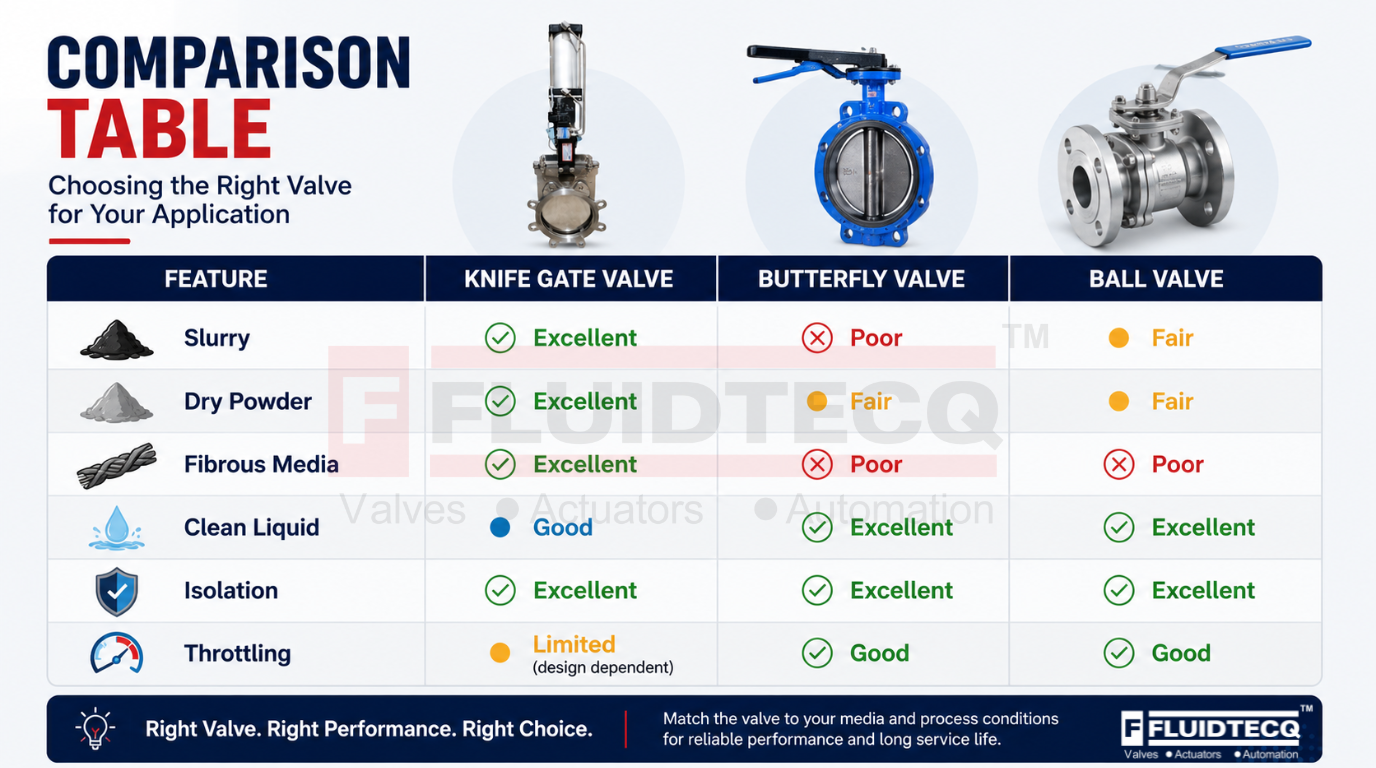
Not every valve is designed for every process. Compare how Knife Gate, Butterfly, and Ball Valves perform across different media and applications to choose the most suitable isolation solution.
Application Examples
Thermal Power Plants — Fly Ash and Bottom Ash Handling Ash is abrasive and prone to bridging in hoppers. A knife gate valve with a suitable wear-resistant lining, sized for the hopper discharge duty, is commonly used for isolation and controlled discharge, often automated for remote and repeated cycling from the control room.
Cement Plants — Raw Meal and Dust Collector Discharge Fine powder handling at silo and baghouse discharge points requires a valve that resists packing and provides a clean cut-off. Automation here supports batch sequencing and reduces manual intervention at elevated or hard-to-access locations.
Wastewater and Sludge Dewatering Lines Sludge is semi-solid, variable in consistency, and prone to fouling conventional seats. Knife gate valves provide isolation at clarifier bottoms, thickener underflow, and dewatering feed lines, where automation supports scheduled or interlocked operation tied to plant sequencing.
Pulp and Paper — Pulp Stock Handling Fibrous stock resists sealing in ball or butterfly designs. Knife gate valves handle isolation duty on stock lines, with bidirectional designs specified where back-pressure or reverse flow is possible.
Mining and Mineral Processing — Slurry Isolation High-solids slurry demands a body and gate material matched to the specific ore or tailings abrasiveness, along with correct sizing to avoid velocity-related wear at the seat.
Chemical, Petrochemical and Hazardous Process Applications — Bonneted Knife Gate Valves
Where the process media is hazardous, corrosive, toxic, or environmentally sensitive, bonneted knife gate valves provide enclosed gate movement that helps minimise external leakage during valve operation. They are commonly used for chemical transfer lines, acid and alkali services, fine powder handling, pharmaceutical intermediates, and other applications requiring improved containment and operator safety.
Manual vs. Automated Knife Gate Valves
A manual knife gate valve is a reasonable choice where operation is infrequent, accessible, and non-critical to process timing. Automation becomes the practical choice when a plant needs:
Remote or PLC-based operation from a control room
Fast, repeatable cycling for batch or dosing operations
Emergency isolation or shutdown response
Interlocking with upstream or downstream equipment
Position feedback to confirm open, closed, or intermediate status
Reduced manual intervention at elevated, confined, or hazardous locations
This is where valve selection and automation engineering need to be considered together, rather than as two separate purchases.
Why Fluidtecq's Approach Goes Beyond Supplying a Valve
Fluidtecq has worked with industrial valve isolation and automation since 1990, across power, cement, mining, pulp and paper, sugar, and wastewater treatment applications.
Rather than treating the knife gate valve as a standalone product, Fluidtecq's selection process considers the complete duty:
Media and application review — matching gate and seat material, lining, and design to the specific slurry, ash, sludge, or powder handling duty rather than a generic catalogue spec
Unidirectional or bidirectional determination based on actual flow conditions, not assumption
Automation package engineering — pneumatic or electric actuator sizing, solenoid valve selection, limit switch boxes for position feedback, air filter regulators, and fail-safe (fail-open, fail-close, or fail-in-position) configuration, built around the plant's control philosophy
Retrofit support for plants converting existing manual knife gate valves to automated operation without re-engineering the entire line
The result is a knife gate valve that is not just sized correctly, but automated correctly — with the actuator, solenoid valve, and feedback devices specified as a matched package rather than assembled from mismatched components after the fact.
Frequently Asked Questions
What is the difference between a unidirectional and bidirectional knife gate valve?
A unidirectional valve seals in one flow direction only, suited to fixed-direction duty like hopper discharge. A bidirectional valve seals in both directions, needed where back-pressure or flow reversal is possible.
Can knife gate valves be used for throttling?
They are primarily designed for on/off isolation. Continuous throttling service is generally not recommended and can accelerate seat wear
How do I know if my knife gate valve application needs automation?
If the valve requires remote operation, frequent cycling, interlocking with other equipment, or position feedback, automation is generally justified. Infrequent, accessible, non-critical isolation duty may not require it.
What is the difference between a bonneted and an open-body knife gate valve?
An open-body knife gate valve is suitable for most slurry, ash, sludge, and bulk solids applications where minor exposure around the gate during operation is acceptable. A bonneted knife gate valve fully encloses the moving gate, making it the preferred choice for hazardous, corrosive, toxic, or environmentally sensitive media where fugitive emissions and product containment are critical.
What information does Fluidtecq need to recommend a valve? Media type, solids concentration, particle size, operating pressure and temperature, line size, end connection type, flow direction, and required actuation (manual, pneumatic, or electric).
Send Us Your Valve Requirement
Share Your Media, Pressure and Size Requirements — Contact Fluidtecq's application engineering team to get help selecting the right knife gate valve and automation package for your process.



 by Hemal Mehta