Beyond Ventilation: Why Heavy-Duty Industrial Dampers are Critical for Mumbai & Pune’s Process Plants
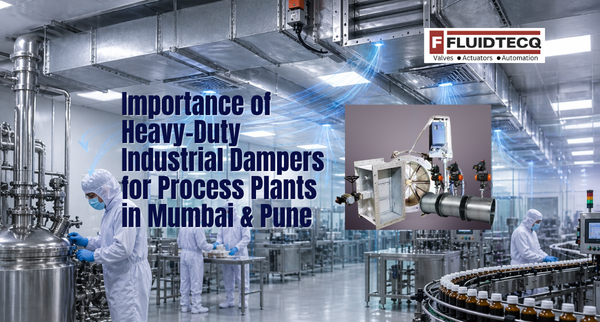
In the highly regulated world of Food and Pharmaceutical manufacturing, the HVAC system is more than just a utility—it is a validated production tool. Whether you are maintaining a Grade A cleanroom in a Pune pharma hub or ensuring hygienic air zones in a Mumbai food processing unit, a standard commercial damper is your weakest link.
In these high-stakes environments, a damper failure doesn't just mean a warm room; it results in failed batches, regulatory non-compliance (FDA/audit issues), and cross-contamination risks.
Pressure Cascading & Contamination Control
Pharma environments rely on the principle of pressure cascading—air must flow from "clean" to "less-clean" zones. This requires surgical precision.
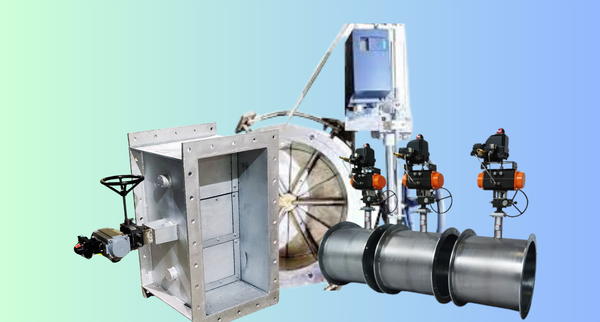
The Fluidtecq Edge: Our Volume Control Dampers (VCD) are engineered for micro-adjustments. When a process room must maintain a constant $+15$ Pascal differential, our dampers provide the stability needed to prevent "pressure hunting."
The Application: Preventing powder migration in API plants and ensuring sterile corridors remain pressurized against ambient contaminants.
Hygienic Design: SS316L vs. The Elements
Food and Pharma plants cannot afford "dead zones" where bacteria or mold can thrive.
Material Integrity: We move beyond standard GI. Fluidtecq specializes in high-polish SS316L Stainless Steel . This ensures the hardware itself doesn't become a source of contamination.
Corrosion Resistance: Essential for plants that undergo aggressive chemical "wash-downs" or those located in the high-humidity, saline environments of Navi Mumbai and Taloja.
Airtight Isolation for Decontamination
When a suite needs to be isolated for Vaporized Hydrogen Peroxide (VHP) sterilization, the damper must act as a 100% airtight barrier.
The Fluidtecq Standard: Our Isolation Dampers feature specialized silicone or EPDM gaskets, providing a "bubble-tight" seal .
Nuclear-Grade Heritage: We apply the same engineering rigour used in our BARC and NPCIL projects to ensure that when a Fluidtecq damper is closed, the seal is absolute and fail-safe.
The "Industrial Zero-Failure" Maintenance Hack
In process plants, the biggest threat to dampers isn't just rust—it’s crystallized process dust and chemical residue seizing the linkages.
PRO-TIP: The 10% Lubrication Rule
The Common Mistake: Most maintenance teams use heavy grease. In industrial plants, grease attracts dust, turning into a "grinding paste" that burns out your actuators.
The Fluidtecq Hack: > 1. Switch to Dry-Film PTFE (Teflon) spray. It provides lubrication without attracting particulates.
2. The 90-Degree Exercise: Every 30 days, force-cycle your dampers from 0 to 90 three times. This "breaks" microscopic surface bonding and ensures that during an emergency or decontamination cycle, the damper reacts instantaneously.
5. Reliability for 24/7 Production Cycles
A seized damper in a food processing line leads to humidity spikes that ruin product texture and shelf-life.
High-Cycle Actuators: Our dampers are paired with heavy-duty industrial actuators designed for the $24/7$ demands of a modern BMS (Building Management System).
Local Support: Based in Thane, we are uniquely positioned to provide on-site technical audits for the MIDC belts in Chakan, Talegaon, and Patalganga.
Why Fluidtecq is the Industrial Partner of Choice
For over 36 years, we have been the backbone of critical airflow projects across India. We don't just sell components; we provide validated engineering solutions.
Validation Ready: Documentation support for DQ/IQ/OQ processes.
Custom Engineering: Built to fit your specific stainless steel ducting requirements.
Certified Excellence: Trusted by India's most stringent technical bodies.
Protect Your Process Integrity Today
Don't let a generic damper compromise your batch quality or audit standing.
[Click here to Request a Technical Consultation or Site Visit] r process is "specialized."


 by Hemal Mehta