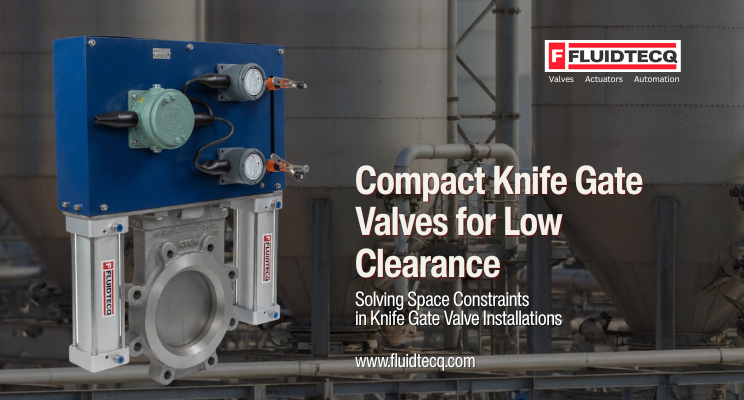
In the pursuit of industrial efficiency, modern plant layouts are becoming increasingly dense. Whether it's a compact chemical skid, a containerized wastewater treatment unit, or a brownfield retrofit inside a century-old cement plant, space is the most expensive commodity on the factory floor — and knife gate valves are often the component engineers struggle to fit into that footprint.
The challenge is the Operational Space Limit. Standard pneumatic knife gate valves are notorious for their height: combine the valve body, the yoke, and the linear actuator, and the total assembly can easily reach three times the pipe diameter. When that assembly meets a low-hanging ceiling, a structural beam, or an overhead pipe run, the project often grinds to a halt.
Why Standard Knife Gate Valves Struggle in Compact Layouts
The yoke-and-actuator stack that gives a knife gate valve its full-bore, unobstructed flow path is the same feature that drives up its overall height. In new-build plants with generous overhead clearance, this is rarely an issue. But in retrofits, skid-mounted systems, or containerized units — where every millimetre of headroom is already spoken for — that vertical footprint becomes the deciding factor in whether a valve fits at all.
The Knife Gate Valve: A Specialized Powerhouse
Knife gate valves are the unsung heroes of heavy-duty processing. Designed with a sharpened "knife" edge to cut through thick slurries, scale, and dry bulk solids, they provide a tight shut-off where standard gate or ball valves would clog.
You will find them at the heart of critical operations in:
Pulp & Paper:Handling high-density stock.
Wastewater:Managing sludge and grit.
Mining & Cement:Controlling abrasive ores and dry powders.
Chemical & Power:Managing fly ash and corrosive media.
The Growing Challenge of the "Tight Squeeze"
As industries move toward modular and skid-mounted designs, the "footprint" of a valve is no longer just about its face-to-face width—it’s about its total cubic volume. Key challenges include:
Actuator Overhead:In many plants, the "sky" isn't the limit. Overhead clearances often prevent standard vertical actuators from being installed or fully stroke-opened.
Maintenance "Dead Zones":A valve might fit, but can a technician reach the packing bolts? Space constraints often force valves into corners where maintenance becomes a safety hazard.
Retrofit Rigidity:In existing plants, piping is fixed. Moving a 10-inch pipe to accommodate a tall valve can cost lakhs in labor and downtime.
Real-World Scenario: The Skid-Mount Dilemma
Consider a manufacturer building a mobile water filtration skid. To keep the unit transportable, the frame height is capped. A standard 200mm Knife Gate Valve with a top-mounted pneumatic cylinder might stand 1.2 meters tall—far exceeding the frame’s limit.
Traditionally, the engineer had to settle for a manual handwheel (losing automation) or use an expensive, slow-acting electric motor. Neither is ideal.
Benefits of Side Mounted Actuators for Knife Gate Valves.
Engineering the Solution: Beyond the Catalog
At Fluidtecq, we believe the valve should fit the plant, not the other way around. Solving space constraints requires moving away from "standard" thinking and into custom geometry.
1. The Side-Mounted Cylinder Design
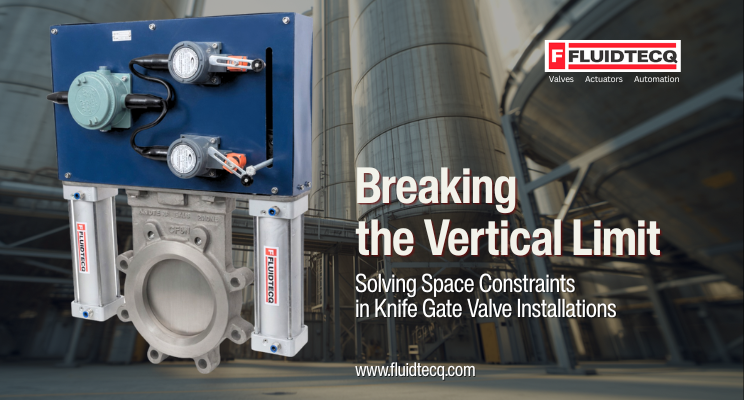
One of the most effective ways to break the vertical limit is to re-engineer the actuation. By using dual cylinders mounted on the sidesof the valve body rather than a single cylinder on top, the total height of the valve can be reduced by 40% to 50%. This "low-profile" automation allows for full pneumatic power in spaces previously reserved for manual valves.
2. Horizontal & Offset Mounting
Where vertical space is zero, actuators can be mounted horizontally or at an offset using specialized clevis and linkage systems. This shifts the "bulk" of the valve into open side-space rather than hitting overhead obstructions.
3. Compact Yoke Assemblies
Reducing the "neck" of the valve through high-strength, compact yoke designs can shave off critical centimeters that make the difference between a successful install and a structural interference.
Best Practices for Selecting Valves in Tight Spaces
When space is a factor, engineers should evaluate:
Full Stroke Height:Always calculate the height of the valve when the gate is in the fully openposition.
Packing Access:Ensure there is at least 150mm of lateral clearance for adjusting the gland packing.
Actuator Weight:Side-mounted or offset designs change the center of gravity; ensure the piping supports are rated for the resulting torque.
Future Trends: The Lean Valve
The future of KGV design is leaning toward integrated automation.We are seeing a shift toward "smart" compact cylinders and telescopic gates that reduce the stroke distance required, further shrinking the installation envelope.
The Fluidtecq Advantage
Space constraints shouldn't force you to compromise on performance. At Fluidtecq, we specialize in bridge-engineering the gap between "standard" products and "site-specific" reality.
Our team doesn't just ship valves; we analyze your GA drawings and plant layouts to provide automated solutions that fit your specific footprint. From side-mounted pneumatic KGVs to custom-engineered actuators, we ensure your process flows smoothly—even in the tightest of spaces.
Does your current project have a "vertical limit" issue?
Contact the Fluidtecq engineering team today for a technical consultation and let us



 by Hemal Mehta