India–EU FTA: How Fluidtecq is Powering the $40 Billion OEM Export Opportunity
Jan 27, 2026
by Hemal Mehta
India–EU FTA: From $75 Billion to $115 Billion —
What It Means for OEM Exporters and Valve Automation
The recently concluded India–EU Free Trade Agreement (FTA) — often called the “Mother of All Deals” — is expected to significantly reshape trade between India and Europe.
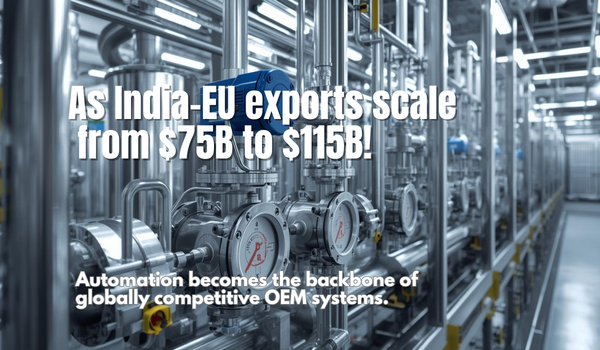
In practical terms: If Indian exports to the EU stand at roughly $75–76 billion today, analysts estimate that a 50% increase could push this figure to $110–115 billion within a few years of full implementation.
For Indian OEM exporters — particularly in food, dairy, chemical, and textile industries — this growth is not theoretical. It represents real projects, real plants, and real demand for automation-driven systems.
Why This Growth Matters for OEM Exporters
European manufacturers are under growing pressure to:
Upgrade aging plants
Improve energy and water efficiency
Meet stringent safety and hygiene norms
Control capital costs
As tariff barriers reduce and trade conditions improve under the FTA, Indian OEMs become far more competitive suppliers of complete plants and systems, not just components.
But access alone is not enough.
Success in Europe increasingly depends on:
Automation depth
Process reliability
Compliance readiness
Lifecycle performance
This is where valve automation becomes a strategic enabler.
As exports scale toward the projected $110–115 billion level, European buyers are actively seeking:
Hygienic, automated processing lines
Reliable CIP systems
Consistent process control
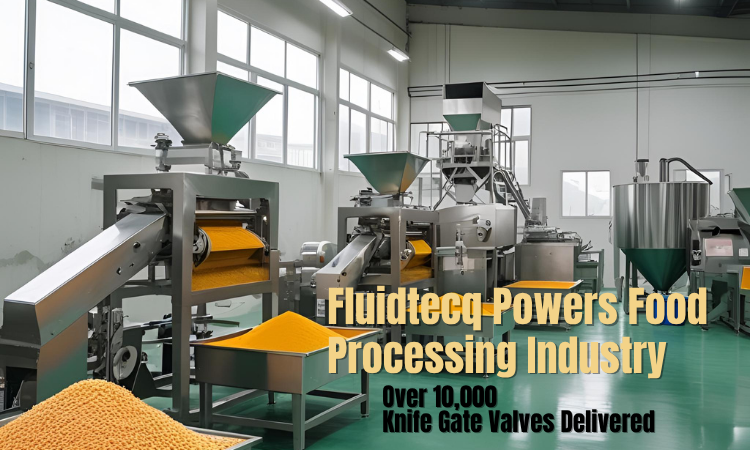
Opportunity: Indian food processing OEMs can deliver automation-rich systems at competitive cost — provided valves and actuators deliver repeatable, dependable performance.
Dairy OEMs
(Milk, cheese, yogurt, ice cream plants)
Dairy processing is one of the most automation-intensive sectors in Europe.
With export growth accelerating:
Mid-sized EU dairies are expanding capacity
Eastern Europe is modernizing infrastructure
Automation reliability is non-negotiable
Opportunity: Indian dairy skids and plants, equipped with dependable valve automation, can compete effectively in a market once dominated by European suppliers.
A significant share of India’s EU exports already comes from chemical value chains — and this is expected to grow further under the FTA.
Chemical plants demand:
Precision flow control
Safety-critical shut-off
Long service life
Opportunity: OEMs exporting reactors, skids, and process systems can strengthen bids by integrating robust, automation-ready valve solutions, improving safety and lifecycle value.
Textile OEMs
(Dyeing, finishing, washing, processing plants)
As exports grow, Europe’s textile sector is investing in:
Water reduction
Energy efficiency
Automation-driven consistency
Opportunity: Indian textile machinery, already globally competitive, gains further advantage when supported by automated steam, water, and dosing control.
How Fluidtecq Is Positioned for This Growth
Reaching $110–115 billion in exports will require more than scale — it will require consistency, compliance, and dependable automation.
At Fluidtecq, we are preparing for this shift by focusing on:
Automation-First Engineering Pneumatic actuators and automated valve solutions designed for continuous industrial operation.
OEM-Ready Integration Products engineered to integrate seamlessly into food, dairy, chemical, and textile systems.
Consistency at Scale Supporting OEMs as project volumes increase and exports expand.
Documentation & Process Discipline Aligned with the expectations of global markets and export-driven manufacturing.
Faster, Local Manufacturing Advantage Shorter lead times and responsive support compared to imported automation.
From Trade Growth to Industrial Transformation
The projected rise from $75–76 billion to $110–115 billion in India–EU exports is not just a trade statistic — it signals a shift in where and how industrial systems are built.
For OEM exporters, automation will increasingly define:
Competitiveness
Reliability
Market acceptance
Valve automation moves from being a component to becoming a core value driver.
At Fluidtecq, we are committed to supporting Indian OEMs as they step into this next phase of global growth — confidently, compliantly, and competitively.


 by Hemal Mehta